
Background
A university residence department wanted to change how they managed campus reservations for lounge rooms in three residence buildings. Originally the Resident Experience Manager handled all requests, but when the manager planned to depart, the department decided to make changes.
Training Requirements and Environment (TRE)
The interview revealed that the manager was the only person who was proficient with the reservation program, Enterprise Management System (EMS). Whenever she was out of the office, a reservation backlog always formed. The student residents, who created the reservation, were the most impacted by the delays. They, in turn, could lower the residence hall’s satisfaction rating by sharing their dissatisfaction in a feedback survey.
Performance could be improved if more people were trained to use EMS. Because our project lead also worked with the manager, he requested more information about EMS. The team lead also confirmed that using the reservation’s confirmation email would ensure that students received just one confirmation email with automatically populated details.
ANALYSIS
The Process
The team focused on a systematic approach to assist the university residence department. This involved gathering the following:
- information about the department
- the reservation software
- the current documentation.
It was important to assist, as there was an immediate residence hall need.
The Report
| Our client liaison was also our project lead, so he arranged for our instructional design team to meet the Resident Experience Manager. Since three of the four team members were unfamiliar with the department and the software, we relied on the class needs analysis document to formulate our questions and answers. We also met prior to the appointment to decide who would ask the questions. Due to the manager’s schedule, and our own, we only interviewed her once, but our project lead could request additional information. |
Learner/Environment Analysis (LEA)
We needed information about the office employees to determine what kind of training would best motivate and engage them. We also needed information about the work environment to determine if there were physical factors that could either help learners focus or distract them. The interview provided the following information:
- The residence office organized its employees into three teams for three residential buildings
- The teams consisted of full time employees and part time college student workers, who were capable of learning the software
- Three leadership staff members, who reviewed the manuals provided by the software expert, also served as training resources to not only lead training, but also act as the point of contact for other staff.
Because the manager reported that the learners were often positive toward authority if they felt that they were respected, she felt that training could be conducted during staff meetings. Each month, one of the three groups had to conduct the meeting in one of the three buildings as it allowed each group to discuss their needs and profile their area. Online training was also needed for employees hired later.
Task Analysis
Learners needed to complete four tasks:
- Confirm a reservation (Resident)
- Create a reservation
- Find and edit a reservation
- Print a reserved room card
Confirming and printing required additional steps. If a reservation required tables or chairs, then a work order needed to be completed with the program TMS. When Main Lounge in Building 1 & 3 was reserved, a printed room card had to placed in the sign holder to indicate that the the lounge was reserved.
DESIGN
The Lesson Plan
To ensure successful training, it was important to engage and motivate the learners to assume the new responsibility, so we relied on principles from Merrill’s Instruction Design Principles, and ARCS Model of Motivation.
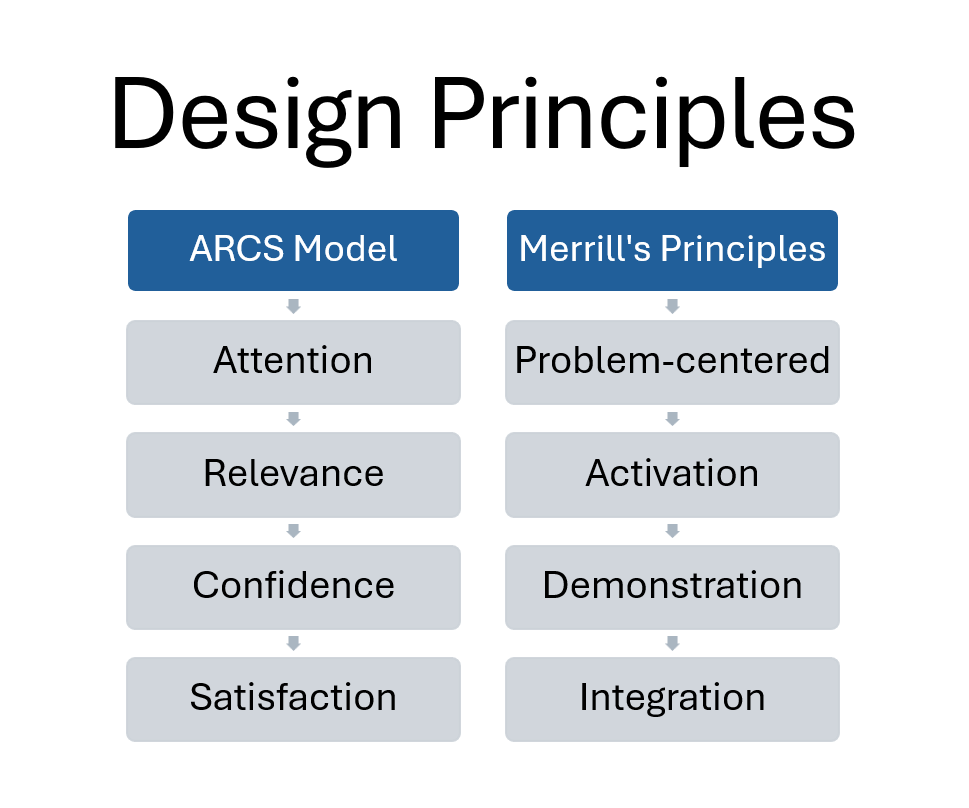
- Attention/ Problem Centered – focusing on a real problem, reservation issues.
- Relevance/ Activation – using existing computer knowledge to build EMS knowledge.
- Confidence/ Demonstration – having demonstrations that allowed learners to experience completing reservations
- Satisfaction/ Integration – activating new learning and motivating learners to demonstrate their knowledge in the reservation hall offices
We then followed the manager’s recommendations to create training in three different formats, videos, handout, and live training. The manager did not want to assume how the employees best learned to review reservations and complete booking accurately.
Four lesson plans were then created to correlate with the four tasks because each task required several steps. An introduction was included, before training started, to provide context for the reservation tasks.
DEVELOPMENT
Once the manager shared her software notes, we applied the ISPI code of ethics for the following:
- Add Value Principle – created content that the client requested. Because the organization was a university, the we added alt tags to all the screen captures to ensure documentation met ADA compliance.
- Continuous Improvement Principle – worked as a team to create and review training content.
- Uphold Confidentiality Principle – did not share software access with anyone outside of the team. We also refrained from sharing or editing any active requests. When creating examples to record for the video tutorials, the we asked for permission first.
References were then created from screen captures and desktop recordings. Additional photos and graphics were selected to either capture the university environment or illustrate a process. We worked together to test, create, and review the documentation.
Implementation
Once the training materials were vetted by the ID lead, the materials were set in the following manner:
- Live training would occur during the monthly meetings that all employee had to attend.
- New student workers could complete online asynchronous training with software videos housed in the university Learning Management System, a program students would use to access other online courses.
- Each residence hall reservation computer would have a reference manual with step by step instructions.
- To ensure that all student workers had EMS access, a dummy account was assigned to each residential reservation computer.
Reflections
Since completing this project, I have created more training for students, student workers, and new employees. Time and experience has made me more mindful to implement the following:
- Use a more detailed systematic model to include comprehensive environment analysis. Given that two full time employees were unable to complete all the current room reservations, what were the checks to ensure that student workers could complete room reservations quickly and efficiently? How were the student workers organized? At what point can student work be checked to ensure room reservations for the student resident satisfaction?
- Interview trainees to check for readiness, and asked to let them vet the training content. Nowadays I either test the learner’s comprehensive by completing certain tasks and then ask for feedback after training. I also recommend that the client track the training results by comparing against the completion rate and satisfaction survey feedback.
 June Haldeman